Saturday, October 21, 2023

Processing bees wax using solar solutions in Perth Western Australia

We had been playing around with multiple different tweaks and setups, follow us along and see what tends to work best for us.


Toolbox inside painted black:

We had one of the Bunnings tool boxes left over and played around to see if we could easily and passively be able to process burr-comb and other old brown comb without the need for electricity or utilizing gas. Basically doing it on the cheap and letting time do its thing rather than us needing the doing, basically every so often filling up those crates with comb and getting a nearly finished product without much doing. However running the unit with black paint on the inside this did not exactly perform very well in the Perth Western Australian winter going into spring time as we had hoped it may  (August-September, early October). Even said the weather was not great, we had hoped to get the box warm enough to sustain the bees wax melting point at around 62-64C Celsius long enough to get it to melt away.


Temperature data indicating that we where not even close of the 64 Celsius needed in spring in order to melt down the bees wax:


weather in those past few days:


Same Toolbox with silver lining / chrome spray:

We changed the setup from painting the inside with a chrom / silver spray to see if we can make a difference. Keep in mind the second test is being done in October, nearly 1 month later and getting closer to summer, which makes a massive difference on the suns position and solar radiation hitting the box. We just kicked this test off and showing below weather data and temperature data once available. But I have the feeling the silver lining will probably do way better, also having said the backing trays will nicely soak up all bounced back radiation.


Weather for the silver lining test:


How to calm bees down - from smokers to sugar water to apisolis and back

The intent of this blog post is to give you an overview into all sorts of methods on how people tend to handle bees. We have tested most of what we show on the blog, if not we will call it out.


Let us know how you handle your bees, let us know what we are missing!


Traditional smokers:

There is nothing like a traditional bee smoker when it comes to beekeeping! Very reliable and works with all sorts of hive sizes, from tiny swarms, NUCs and even large production colonies or pallets worth of colonies.


Due to burning holes into our polystyrene hives with the traditional smoker when resting the smoker on the next hive while working away we have amended all of our smokers with a slight under tray to avoid placing the hot under body of the smoker onto the plastic or poly hives burning holes into the hives. its a simple little fix which works like a charm and is way cheaper than buying or fixing hive lids!


Bee-Z-Smoker:

We had tried the Bee-Z-Smoker which operates on batteries and heats up a metal wire, which is intended to smolder wood shavings as smoker fuel. If I remember correctly the battery did not last very long, its powered by rather heavy batteries, unsure if they are lithium or not, but they felt heavy. It does work, a few seconds after pushing both buttons it generates cool smoke. Its not super thick smoke, but plenty to work the bees.


Sugar Water:

In europe many beekeepers rely on spraying the bees with sugar water to enforce them to clean themselves and are taken out of the "action" as such. I'm not sure how one moves bees out the way using sugar water mist as I would imagine that sugar water is mainly used in combination with swarms, but I might be wrong. I myself do not use Sugar Water in our operation.


Essential oils and water misters:

We had just recently tested using essential oils and water mist spray.

Tea trea oil:   
Bees seem uncoordinated in defending, still upset but not sitting on your sleeves stinging you to death.

Spearmint oil:
Spearmint had been said to be beneficial while one should stay away from lemon or banana scented essential oils, however we are still waiting for our supply to arrive and will update the blog once tests have been conducted.


Liquid Smoke:

We tried this in order to work the bees on harvest ban days, as we had our bees stationary and could literally walk to the hives. We tried this, however upset hives do not seem to react as intended. When accidentially sprayed onto hands and sleeves, we noticed that bees tended to avoid that area, so partially it seemed to work, just not so well on one of the really upset hives. The liquid would probably be sprayed just like the sugar water.


Food Smokers:

Food smokers sometimes can be handy assuming you are working with NUCs in bee house settings or similar and solely need to direct the bees from their frames or edges and need tiny amounts of smoke.


APISOLIS:

We have tested and introduced APISOLIS in October 2023 and it seems to be handy for NUCs however we used it on a day where one of our bee sites had not yet been slashed and the grass / hay was all around the hives at nearly knee height while the outside temperature was already around 35C and very dry.
It would have been way too dangerous to light a smoker that day, and use it on that site in that setting, hence we were quite surprised on how well it worked on our production hives. However, keep in mind that our hives are fairly well behaved, and we got away on production colonies on the hot day. However, one seems to go through quite a bit of fluid.
What we usually do is to add the magnetic charger knobs as beekeeping equipment and bees wax / propolis and usb charging ports don't do well in our experience.


If we missed a major gadget or you may have an idea you would like to share with us, please contact us and let us know an what you are using to calm down your bees.

Monday, October 2, 2023

Who left the tap / honey gate open? - Haven't we all been there? Is there a potential solution?

Most beekeepers will experience this at some stage we're pretty sure off.


Honey spills.... overflowing buckets... and having left the tap open!

Who has not left the honey gate / tap open and walked away in distraction. Quickly picking up the phone call while the honey is steadily filling that bucket in the background.
Then you get called to a different room / location for a "quick job" which ends up in another tasks or simply you forgot what you were doing..

And there you have it. Honey spills are costly and a pain to clean up, but honestly, have we not all been there?

So, while playing around with a water leakage sensor / tea bucket water alarm we noticed that the alarm went off pretty reliable when we stuck it into our honey bucket for testing purposes and made us think of a simple solution to avoid honey spills in future.

Our creativity and fantasy could easily imagine that someone on the internet may build a custom stainless-steel version of this to make beekeepers life an easier one.

It seems to work, still needs a bit of testing in "real" life with filling buckets, however when I stuck it into my honey/tea bucket it seemed to alarm fairly consistent.

Who knows, when there will be a food-grade commercial solution around this?

It be handy to have for sure!

Meanwhile we had tested this unit here, picked up from Jaycar:

Smart Wi-Fi Water Sensor - Smart Life Compatible | Jaycar Electronics

Feel free to play around with this topic and sensors and send us your pictures and creative solutions around the topic of honey spills.


Friday, September 15, 2023

Trailer tips when beekeeping

 This post is just to document of things we came across when beekeeping and using trailers or just generally good not to forget...

Trailers, D-Shackles and loosing the pins:

When attaching D-Shackles, ensure the pin / cap is the to the top, as with vibration and time you tend to buy more pins, as they literally just drop out. When facing towards the top, gravity can work its thing while most time they don't tend to fall out.


Paint your trailer edges white:

when operating mostly at night when shifting bees, its way easier to see your trailers position in the mirrors at night. Even when just having standard break lights, the white color lights up nicely, while most other colors being reflected by red light appear very dark and are barely visible, especially in your mirrors.


When using red flood lights to work bees and white markings on trailers:


Notice the difference of the olive green / gray trailer body versus the white parts under red lights, what a difference that makes! Just imagine how much easier that will be in your mirrors when reversing!

Working alone strapping trailers and mirrors:


When working mostly alone, then strapping can be a bit of a pain, as the hook keeps slipping off the railing and you end up walking backwards and forwards.

I tend to strap stuff by putting the strap through the metal hook, this way one side will not be going anywhere if using small straps.


I usually ensure that all rachets are located on the driver side, as when something where to becomes loose, I would be able to see the straps better flying around within the mirrors fairly soon and could pull out to fix it up instantly.
The driver side mirror will probably give you a better view than the passenger side most times, especially in the dark.


Trailer tray pins:

just get into a habit to put things back to the same place every time, and place especially pins back into their locking positions before doing something else, or face getting distracted and placing them on the tray where you loose them during your second additional distraction.... Yes, been there done that.
Best to have someone weld a chain on them so you can't loose them.


Flat top trailers and missing rails:


When using the 6m flat top trailer from Kennards for instance, the trailer does not have a rail underneath the trailer end to end and no real good position to attach the straps.
Now there's always multiple ways to solve things, and one solution I had seen used by another beekeeper was to use a chain in between the tie-down points of the trailer, and then strapping the hives onto the horizontal chain between the rails. Just ensure you use a decent sized chain and calculate the breaking point of the chain when factoring the number of hives and their weight at an impact speed of maximum 100km/h and calculate the force required for the chain specifications for your requirements.


Ensure you have plenty of clearance between the wheels and the chains when loose and not in use / no hives on the trailer and add straps as needed to avoid the chains coming close into the wheel space when dangling down.


The below picture was taken during the time when "DingDong Fabian" from Sun City Honey helped me out on a Canola shift and saluting in taking instructions :), as we had to improvise after noticing the rather large gap of the missing rails last minute and strapped some pallets onto the trailer, and then strapped the hives on top of the added pallets to keep us going on time. There are always multiple ways to do the same thing, just ensure your straps are rated for the job at hand, ensuring that even if you had an accident, nothing would fall of the trailer at any time and nothing moves which should not.


Spare tyres and trailers, and the time when the trailer tyre overtook me going up hill!

True story, one a shift we once did moving hives up into the Perth hills going onto a Marri/Redgum flow, I suffered flat tyre situation, where the tire had cut itself of the rim.
I heard my brother over the radio advising me to watch out for the Kangoroo jumping across the road, when i noticed my trailer tyre starting to overtake me, which my brother had mistaken for a Kangaroo bouncing across the road. Yep, carry spare tyres on your trailers, and ensure periodically that your spares are pumped up and ready!

Floral Sources: Gingin WA


Floral sources in Gingin:


This blog post goes into what is flowering around our site in Gingin in September 2023:

Its floral sources which have been found around Gingin area from beginning to end of September:

This is what we would call "mixed blossom honey":


October / November 2023:

Australian Xmas Tree


Thursday, September 14, 2023

Hive lifter tools and solutions - transporting hives the easy way

Hive lifting, moving and relocation solutions:


This Blog post will probably be a "living document" as we discover the different types lifters and products we will update this page. Over time this will be a compendium of methods to pick from.


Shifting bees at night and red flood lights:

One thing to note first is that bees are being shifted in the dark as all bees are home by then.
the other thing to note is, bees do not easily see red light hence it makes it perfect to illuminate the working area with read light as shown above:


Read our blog post around illumination here:  Shifting bees the easy way using red light


So, lets get back to the topic...


Manual:

- Not recommended due to manual handling and issues with weight and slips and trips.

Either 1 or 2 persons carrying the hive by the box, or by the straps. Usually the lids slip, or bottom boards move and the bees crawl out and you are in direct contact with the bees streaming out, and stinging the living XXXXXX out of you. This is how we started, and its not a good way, 2 guys and a ute, but most people will probably start right there.


Trolleys:


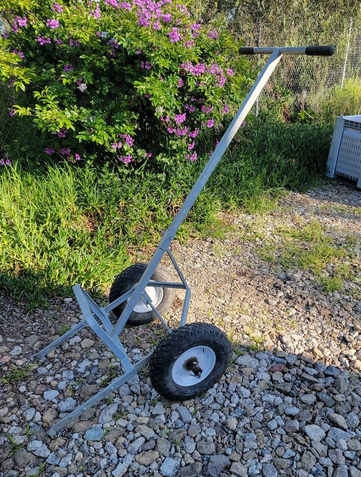
Using a trolley like this in combination with a flatbed trailer using ramps is probably a better idea than lifting them manually of the trailer. Ensure the trolley has large wheels that do not dig themselves into soft underground. Also ensure that your ramps are not too steep or to slippery when dragging the hives up or down ramps. Keep the hives strapped while relocating, or you will "bee" in pain!


Home made hive dolly found on Facebook Marketplace:


Kaptar Lift:

Manual or Electrically powered:

We had purchased the manual kaptar lift, as there had been chit-chat about charges only lasting for a certain amount of shifting and also stories about the electrical malfunctioning during rainy nights, in our case we don't have much time to mess around with equipment hence the decision to be manual as it has a set speed, and low / consistent failure rate if at all and can be planned / calculated with.

In recent shifts we noticed that the combination of a regular trolley as above is working quite efficient in a 2 trailer setup. As 1 person is bringing the hives with the trolley above and the second person using the kaptar lift, "forks them" on to the flat bed if not using the ramps depending loading angles etc. It seemed to work quite efficiently that way.


For jobs up to 20-50 hives this tool is working fine, and handy on the smaller ones too as shown below:


AWD Kaptar lift - electrical:


Same version as the manual, with exception that you have powered wheels and the lifting is done by press of a button.


We had temporarily experimented with red light strips on the Kaptar lift to aid with the shifting at night. I think we picked them up at JayCar, however that experiment only lasted 1x shift until the cables ripped out the LED strip. Also having said that the light emitted from that particualar strip was not very bright. We used a power bank with the USB strip, which we are sure could be built to perfection, as we noticed its rather dark, right at the spot where one wants to drop off the hive, and one usually is standing in the light of the vehicle based red light flood lights from the car. The lifter red light has still got room for improvement!


Peter Debicki's tail gate lifting solution / Kaptar lift action:

Found on a Facebook beekeeping group:

This tailgate lifter is made by Healy group, and allows for a simple 1 person operation of ute sized loads. I imagine this could also be mounted to trailers potentially.


B2 Hive lifter from BeeBreedingCentre.com:

I stumbled accross this lifter the other day by accident and found it quite interesting.
Some people are using the Kaptar lifts similar to the B2 shown here, as in lifting of the supers and using the lifters to help under or over super with heavy boxes, taking the weight of your back.


What I do like is the "paddles" shown on this lifter, locking the boxes in place when picking up, but allowing them to slip down into position. I kind of like the engineering in this solution.
We've been told that the "paddles" are built from butt hinges, so feel free to be mechanically creative and build them yourself, as we have not found a commercial entity selling them as such.


HiveHelper:

Discovered on a Facebook Group:

http://www.hivehelper.com.au/


Brick Trolley:

Just recently by coincidence I noticed Brick Trolley's which may be beneficial when moving heavy honey supers assuming you have a little crew going, this trolley might come in handy! 


Trailers:

Trailers and beekeeping just seem to have a tendency to grow, until the maximum is reached. It was no different in our story, first started with a 6x4, 8x4, 6m flat top trailer, MR truck with posi truck.


Kennards:

all those lifters go very handy with rented trailers such as the 6m flat top trailer from Kennards as shown below.
You may decide to wheel your hives on to the tray using some form of ramp or simply just fork lift them on to the tray and move them manually into position once on the tray.
However, using this trailer please ensure you start loading from the front of the trailer to ensure the weight at the front, pressing the axle and weight on your rear tyres of your car, or you will face a "swinging trailer" due to unsafe weight distribution on the trailer.


MoveYourself Trailers 24h:

Recently we have discovered Move Yourself trailer hires, especially the 10x6 trailers with loads up to 1499kg. The cool thing is that the return is 24h, as there are distributed 24h fuel stations which offer pickup and return anytime of the day/night. Meaning you would probably be able to get away with an 8 hour lease rather than a 24h one, as you can still return the trailer 02:00 in the morning once you are done with the shifting for instance, rather climbing out of bed early next day to return the trailer. Also the trailer comes with a ramp which drops down 1.2m at the back. It may be a bit steep to go up and down with a trolley or Kaptar lift, especially in the night and with due setting in and making everything slippery. Hence we would suggest taking an extra ramp to lower the ramp angle to make things easier and less dangerous. A foldable wheel-chair ramp may just do the trick. Ramp Champ – Australia's Largest Range of Ramps | RampChamp.com.au might be a good stop to have a look.


When comparing the long flat top trailer from Kennards with the MoveYourself trailer, the GVM ratio is way better on the MoveYourself one. Also when dragging back full honey supers you may be able to return more honey using the 10x6 trailer.

Honey load calculations:

For example the Paradise System 10 Frame WSP supers containing drone comb at 7.2mm cell size, are around 26-29 kg, frames and boxes together.

1499 / 29kg =  ~ 51 Supers which could be returned using this super.

The Paradise honey boxes usually fully built frames weigh somewhere around 5-6kg themselves, so out of this you would probably end up with 22kg of honey per box 

So 50x boxes in total would yield in 1100kg of honey using the 10x6 trailer and a lot of lifting!

Peter's trailer:

being able to drop down the rails on a trailer is a nice addition and makes load safety fairly simple and fast. You can also see the tailgate lifter on this picture rarely consuming any extra space.


Manual vehicle / trailer based lifters:

Healygroup.com.au seem to have all sorts of handy heavy duty lifting equipment which may be of interest. The one shown on this picture however limit you to lift up or drop down very close to the proximity of your vehicle or trailer. Unless you combine this method with a trolly to then move the hives further away from your vehicle, which could combine both worlds and make it fairly efficient with a two-person team.


Maxilift or Kevrek

Buy a maxilift or Kevrek second hand, and combine the operation with dropping them on the floor and running them into position with the trolleys. Doing this in a two man band can be a very fast operation one person dropping them on the floor, the other rolling them into position.


EasyLoaders and trailers:

This picture is courtesy of Troy Watson kindly sharing his setup constructed by EzyLoader.
The loader is powered by the vehicle 3x 12V batteries. 
GVM is 3.5 tonne Troy gets 36 doubles on it and can load another 36 triples on top.
Trailer is 5.5 metres long by 2.1 wide. 

Its quite a cool setup for the semi-commercial beekeeper getting a bit sick of Kaptar lifts and or other manual means.


EazyLoader300

Make sure you visit https://www.youtube.com/@aCanadianBeekeepersBlog as I follow Ian along on his journey and he is happy and heavy adopter of the EazyLoaders which seem to work well in his operation. Assisting his team with transporting/deploying hives as well as tasks such as under suppering without ever carrying the weight manually.
However, they come with a bit of a price tag.


Dingo's

There are all sorts of rental places where you can pick up a Dingo for fairly cheap pricing for the day.

I can recommend https://thehireguyswangara.com.au/products/dingo-hire/  when you are located in Perth WA. 

Once you get a introductionary mechanized tool, you will encounter that you will need either a plant trailer, or will operate some more serious truck / MR or even bigger sized vehicle. Now you need heavy duty ramps, and the required GVM on trucks and trailers to make the trip efficient while ensuring you are not overloading your truck in weight or having uneven weight distribution, as well has having the right heavy-duty straps.
Also sites which may have been working for you using smaller tools may no longer be suitable for the slightly bigger equipment you bring along, in terms of mobility and or noise / an nuisance issues to neighbors.


BobCat / Possi Tracks:


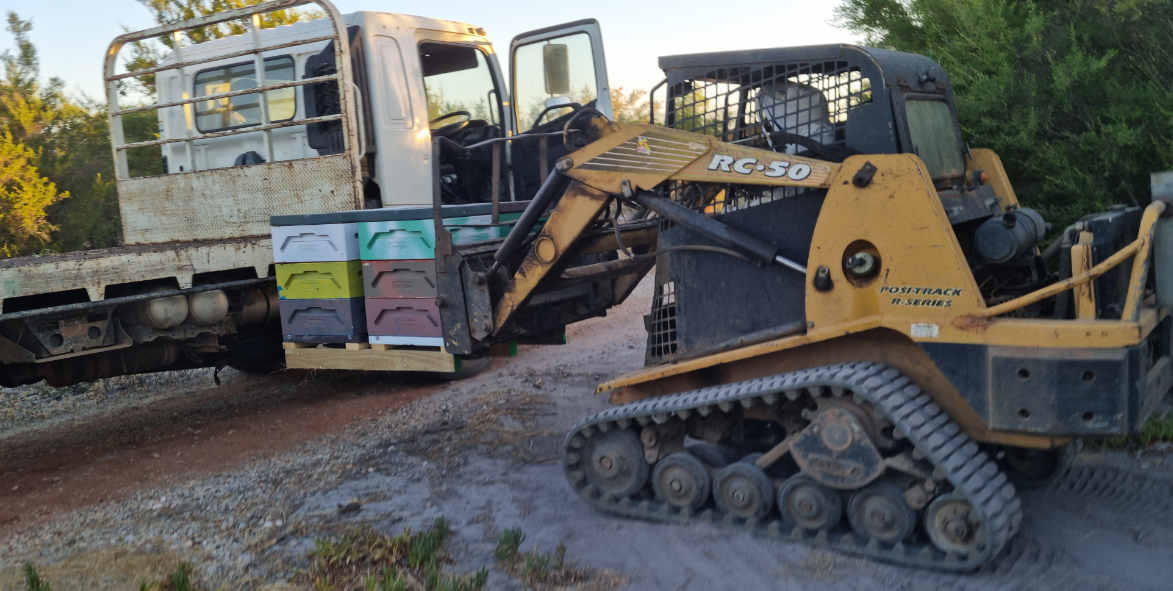
And at some stage you end up with MR sized trucks with heavy duty plant trailers and some form of loader, in this case its a posi-track and having customer 4 way pallets setup.
However, once again, your choice of site now has shifted potentially again, as not all sites will allow such heavy equipment in and out, while at others the tracked vehicle is nearly mandatory to avoid bogging and or climbing steep angles with the hives.
And to be truthfully honest, the posi is just a cool tool to toy around with!


Where ever you are in your beekeeping journey, let us know how you shift your hives so we can add it to the above list!

Happy beekeeping,

The QuickWings Team

----------------------------------------------------------
Our content is for informational purposes only and do not form a professional relationship. 
Please refer to the full disclaimer on Quickwings pty ltd’s website found here: 
https://quickwings.com.au/policies-and-tcs/
----------------------------------------------------------